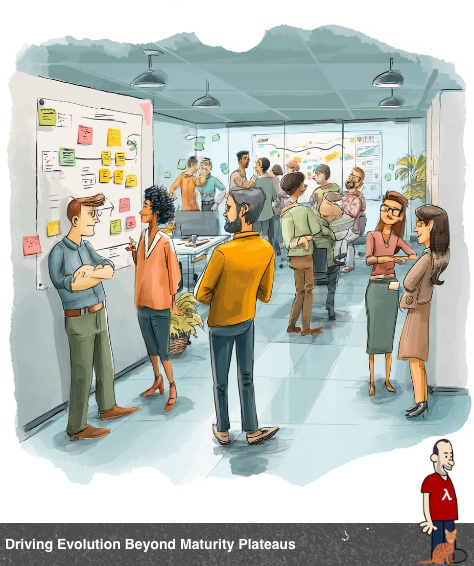
Too many organizations treat their current Kanban Maturity Level (KMM) as a destination rather than a waypoint. The Evolutionary Change Model warns that this “happy equilibrium” at ML1-ML3 is often a mirage—fueled by hubris, complacency, or sheer lack of ambition. The problem is clear: when teams get comfortable, flow efficiency stagnates, systemic impediments stay buried, and business agility erodes just when markets demand more. If we accept the plateau, we condemn ourselves to mediocre lead times, brittle practices, and talent that quietly disengages.
What we must learn is that maturity levels are designed to be disrupted. Each level represents a stable system of policies, feedback loops, and cultural norms; to climb higher, we need intentional tension that makes the current state uncomfortable. The Evolutionary Change Model teaches us to introduce small, safe-to-fail experiments that chip away at outdated assumptions while reinforcing new behaviours until they become the next equilibrium. Progress is not a leap but a series of deliberate nudges—visual controls that reveal hidden queues, metrics that expose the cost of delay, and coaching conversations that surface resistance.
As a Tech Manager, translate this into an actionable roadmap:
1️⃣ Diagnose the plateau – run a KMM assessment and map key practices already mastered versus those missing at the next level.
2️⃣ Select one catalytic practice aligned to business pain—e.g., implement explicit WIP limits at the discovery workflow to expose demand–capacity gaps.
3️⃣ Create “shock-absorber experiments”—time-boxed, observable, low-risk changes that disrupt the comfort zone without jeopardizing delivery.
4️⃣ Amplify feedback loops—use daily team reviews and flow metrics (lead-time distribution, blocking-age charts) to make the tension visible and actionable.
5️⃣ Stabilise the new equilibrium—once benefits are proven, formalise policies, celebrate wins, and immediately identify the next limiting practice to unsettle.
By continuously destabilising lower-level equilibria and guiding teams toward ML4-style resilience, you ignite a culture where improvement is not an event but an expectation. Each incremental change compounds, accelerating flow, elevating morale, and positioning your organization to out-learn its competition.