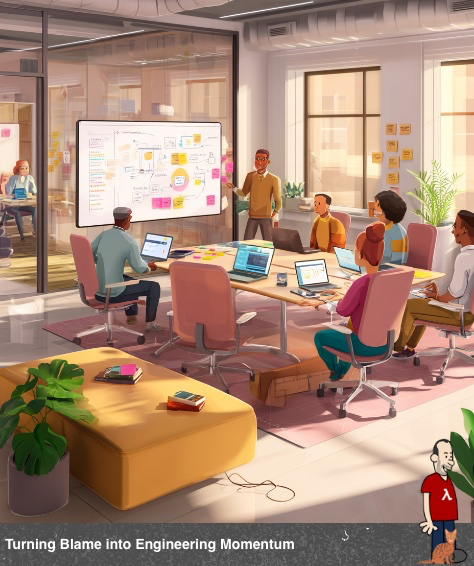
Blame is the silent tax on every software organization. When delivery slips, fingers point at legacy vendors, “bad” languages, or elusive requirements. Morale dips, defect queues rise, and complexity compounds because no one feels accountable for untangling the mess. The Pragmatic Programmer cuts straight to the heart of this problem: “Any and all of these may play a role, but it is up to you to provide solutions, not excuses.” The first step to escaping the big-ball-of-mud spiral is acknowledging that while context shapes our constraints, ownership shapes our outcomes.
The key lesson is deceptively simple: pragmatic professionals trade blame for agency. They treat obstacles as design inputs, not defense exhibits. That mindset shift redirects energy from fault-finding retrospectives to forward-looking experiments. Teams that internalize this principle build psychological safety around trying, measuring, and refining. Over time, that habit compounds into technical excellence—fewer hand-offs, tighter feedback loops, and architectures that evolve instead of ossify.
So, how do we operationalize this insight? A Staff Engineer can seed an ownership culture through three deliberate practices:
(1) Observability-first planning—start every initiative by defining success metrics the team controls, making external dependencies explicit but never deterministic.
(2) Blameless decision records—log trade-offs in lightweight ADRs that document context, constraints, and chosen mitigations, then revisit them when reality changes.
(3) Solution-oriented rituals—reframe stand-ups and post-mortems with the prompt, “What experiment will reduce this risk next week?” rather than “Who caused the issue?” By championing these practices, the Staff Engineer turns abstract accountability into visible, repeatable behaviors.
The payoff is strategic as well as technical. When excuses evaporate, the latency between idea and impact shrinks. Teams learn faster, refactor sooner, and align more closely with business objectives. Instead of dreading change, they welcome it as a chance to validate assumptions and sharpen their craft. That virtuous cycle—own, act, learn—propels individual careers and organizational competitiveness. In a landscape where adaptability trumps perfection, choosing solutions over blame isn’t just professional etiquette; it’s a decisive engineering advantage.