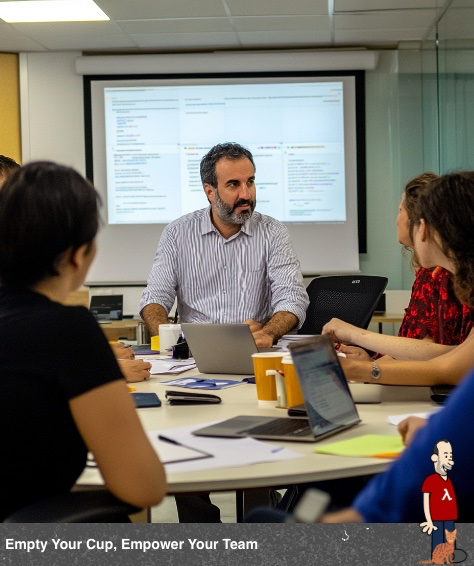
In Bruce Lee’s striking thoughts, we encounter a timeless Zen parable: “A learned man once went to visit a Zen teacher to inquire about Zen. As the Zen teacher talked, the learned man frequently interrupted to express his own opinion about this or that. Finally, the Zen teacher stopped talking and began to serve tea to the learned man. He poured the cup full, then kept pouring until the cup overflowed. ‘Stop,’ said the learned man. ‘The cup is full, no more can be poured in.’ ‘Like this cup, you are full of your own opinions,’ replied the Zen teacher. ‘If you do not first empty your cup, how can you taste my cup of tea?'”. For Tech Managers, this story is not just a philosophical musing—it is a call to address a common problem in the workplace: the resistance to change and the stagnation that arises from closed-mindedness. The inability to remain receptive to fresh ideas can hinder personal growth and team innovation in an industry that evolves quickly.
The lesson here is clear: we must learn to empty our cups. In a technical environment where complexity and rapid change are the norms, clinging to outdated processes or preconceived notions can lead to inefficiencies and missed opportunities. The parable teaches us that continuous learning is essential for mastering the art of software engineering. By acknowledging that there is always more to learn, Tech Managers can inspire their teams to abandon rigid frameworks and embrace a mindset of exploration, discovery, and perpetual improvement. This transformation is vital for overcoming the challenges of managing complex systems and coordinating large-scale projects.
To implement these insights, Tech Managers must actively cultivate a culture that encourages intellectual humility and continuous learning. Begin by creating safe spaces for open dialogue where team members are invited to question established practices and propose innovative solutions. Implement regular retrospectives and innovation sessions that focus not only on successes but also on the lessons learned from failures. Encourage your team to experiment with new technologies and methodologies, fostering an environment where constructive feedback is valued over dogmatic adherence to old paradigms. This proactive approach not only resolves the problem of stagnation but also lays the foundation for sustainable, agile performance.
By embracing the philosophy of emptying our cups, Tech Managers can transform their teams into dynamic, adaptable units that are always ready to learn and evolve. Lead by example: regularly assess your assumptions, remain open to new ideas, and champion continuous improvement across every level of your organization. In doing so, you address the immediate challenges of managing complexity and empower your team to drive innovation and achieve lasting success in today’s ever-changing tech landscape.