Problem · Ambiguity Breeds Outages
When “change” has no shared definition, every team improvises its own. One squad patches a database at noon, another tweaks firewall rules at 3 a.m., and suddenly customer traffic vanishes while finger-pointing begins. The Phoenix Project passage captures that chaos: until change was clearly defined—any physical, logical, or virtual activity that can impact delivered services—nobody knew what to coordinate, document, or safeguard. The result was shadow deployments, surprise failures, and a backlog of emergency fixes.
Lesson · Clarity Fuels Autonomy and Safety
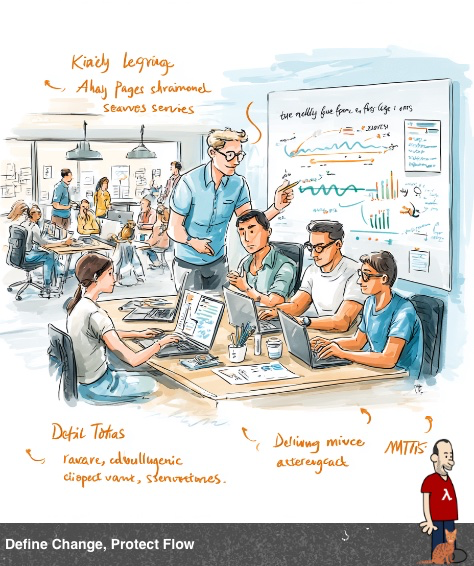
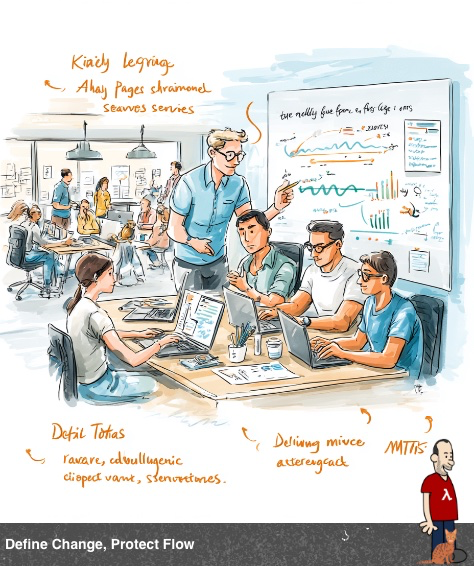
A single, explicit sentence on a whiteboard realigned the entire organization. By agreeing on what counts as change, teams could finally plug into a unified pipeline of review, testing, and release. The takeaway is powerful: operational excellence starts with lingua franca. Once everyone speaks the same language, automation, governance, and speed reinforce—not oppose—each other.
Action · Tech-Manager Playbook
1. Codify Change – Host a 30-minute workshop to craft a one-line definition tailored to your stack. Include apps, infra, data, and even feature flags.
2. Embed It Visibly – Post the sentence on Kanban columns, Jira templates, and pull-request checklists. Clarity must live where work happens.
3. Route through a Single Path – Build or refine your deployment pipeline so all defined changes pass automated tests, peer review, and a lightweight CAB (Change Advisory Bot).
4. Measure & Iterate – Track lead-time from change commit to production and mean time to recovery (MTTR). Use outliers to fine-tune policy, not add bureaucracy.
Outcome · Flow with Confidence
With a shared definition and a single path, engineers move faster because the risk is controlled, not despite it. Incidents drop, recovery accelerates, and business stakeholders see a pipeline that delivers innovation without gambling on stability.